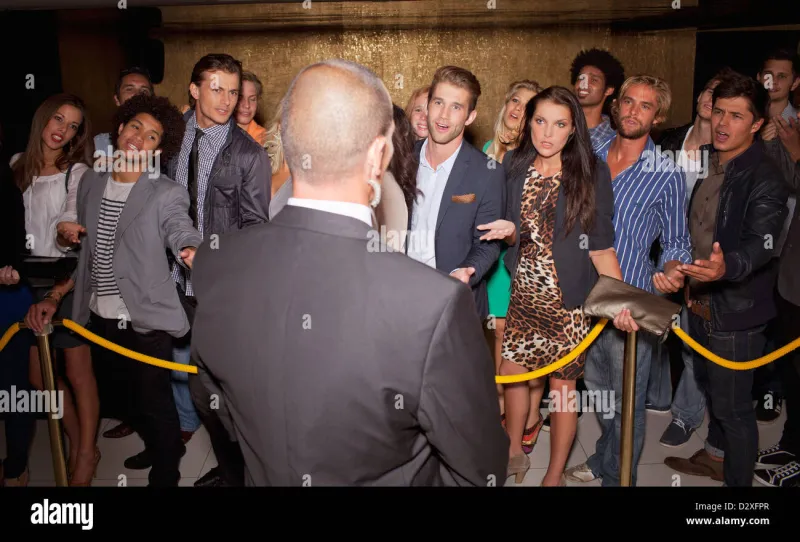
Seven Seconds at the Rope: The Door Staff Who Read You Like a Betting Slip
There's a moment that happens outside every club in London, every night of the week, that nobody films and nobody writes about. You walk up. You clock the bouncer. The bouncer clocks you back. Maybe three seconds pass. Then one of two futures begins.
Most of us treat that exchange like weather — random, uncontrollable, occasionally unfair. The people who work the door will tell you something different. It's not weather. It's a bet. And they've got years of evidence on their side.
The Seven-Second Ledger
"People think we're judging them," Marcus, who's worked doors in Shoreditch and Dalston for over a decade, told us. "We are. But not how they think. I'm not asking if you're a nice person. I'm asking if tonight, this venue, this crowd — are you going to add to it or take from it?"
He calls it the ledger. Every punter arrives with an invisible column of debits and credits, and the door staff balance it in the time it takes you to get your phone out.
Some of the entries are obvious. Are you steaming? Are you in a group of fourteen lads? Is someone already crying? But the interesting stuff is quieter. Walking pace — too fast reads as aggro, too slow reads as wrecked. Where your eyes go when you reach the front. Whether you're talking to your mates or at them.
And then there's the one everybody suspects: the shoes.
The Shoe Theory Holds Up
"Trainers tell you more than a passport," says another doorman we'll call D. He's worked Mayfair and he's worked Peckham, and he says the calculus changes by postcode but the method doesn't.
"Mayfair, it's almost comical. If the shoes cost less than the taxi, there's friction. But it's not snobbery for snobbery's sake — it's shorthand. Someone who's dressed for that room has read the room. Someone who hasn't is telling me they haven't done the research, and that usually travels with other things."
Out east, he says, the equation flips. Overdressed reads as effort, and effort reads as a night out, which reads as fine. The constant isn't the shoe. It's whether the shoe matches the intention.
Which is all very charming until you notice who the shorthand tends to fail.
The Vibe Is Not Neutral
Here's the uncomfortable bit, and the door staff we spoke to were refreshingly upfront about it. "Vibe check" is a lovely word for a system with no accountability. It's a judgement call made in seconds, by a human, under pressure, working a queue that stretches round the block. Humans pattern-match. Pattern-matching plus discretion equals a filter that doesn't always land evenly.
More than one person we spoke to acknowledged it plainly. Groups of Black lads get the stricter read in certain postcodes. Big groups of working-class women get read as "trouble" when the same energy from a hen do in kilts gets read as "fun." One veteran put it like this: "The door reflects the street. If the street's got a problem, the door inherits it."
Some venues have moved to written refusal policies, body-worn cameras, decision logs. It's better than nothing. But you can't log a feeling, and the feeling is the whole system.
What They're Actually Buying
So what is the door selling, when it sells "vibe"? Sit with that for a second, because it's stranger than it sounds. A bouncer on a Friday night isn't really keeping out troublemakers — the actual troublemakers are mostly already inside, they're just quieter about it. What the door is curating is a probability distribution. A sense that everyone in the room is roughly here for the same reason.
That's why the questions at the door feel so absurd and are so load-bearing. "Who are you here with?" "Where'd you hear about us?" Nobody cares about the answer. They care about how you answer. Hesitation reads as a story being assembled. Fluency reads as a night out.
One doorman summed it up in a way we keep thinking about: "I'm not letting people in. I'm letting a mood in. You're either carrying the mood or you're not."
Play the Long Game
The advice from the people who know is almost boring. Come in smaller groups. Go to the venue whose crowd you actually want to be in, not the one with the best Instagram. Learn one door person's name. Be the regular who tips and waits their turn, because the door has a long memory — longer than yours.
Because the truth about the seven seconds is that they're never really seven seconds. They're the sum of every queue you've ever queued, every outfit you've ever picked, every Friday night you've ever had or never had. The bouncer's just reading the receipt.
And if that sounds unfair — it is. But it's also the last live judgement call in British nightlife, made by human beings, in public, on a pavement, every night of the week. You can hate the blackjack table. It's still the most honest game in town.